
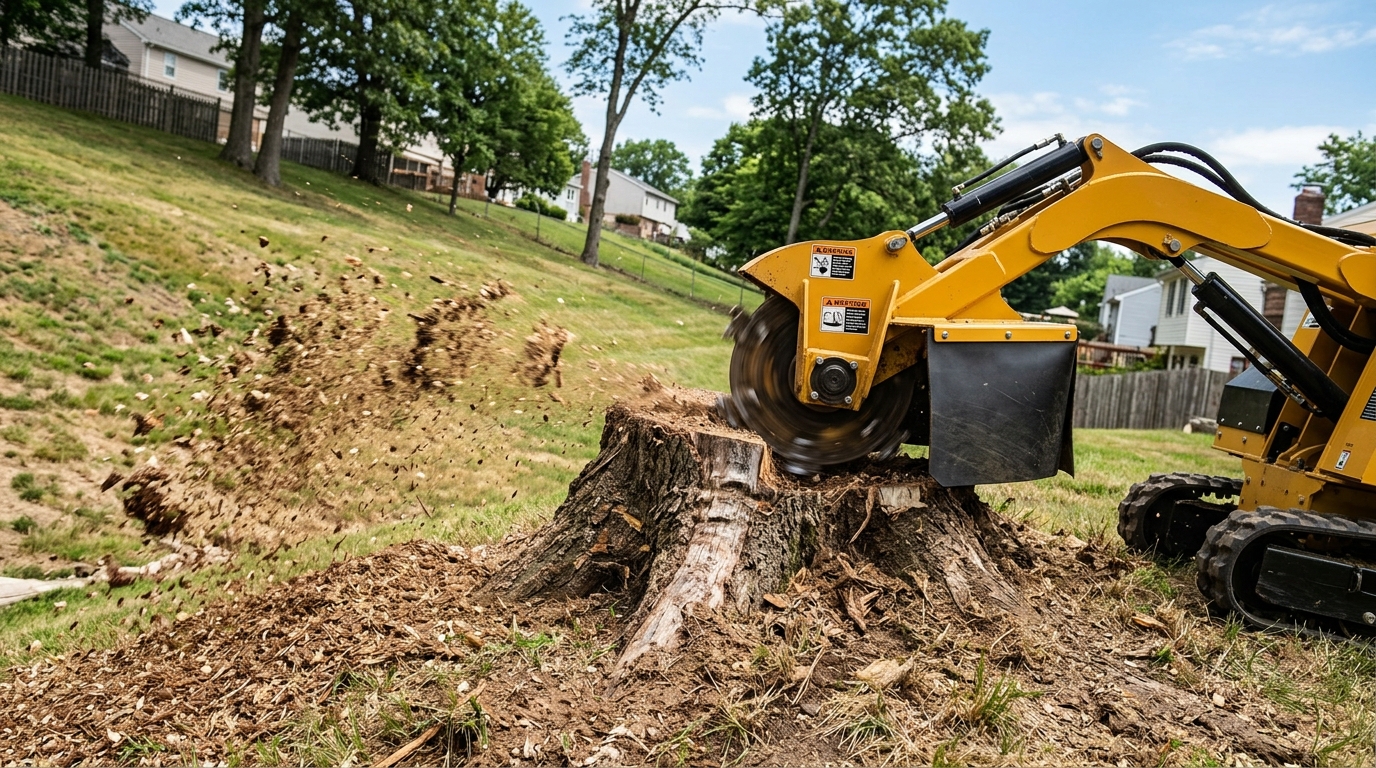
A stump sitting in the middle of a flat backyard is a straightforward afternoon. A stump halfway up a grade behind a house off Hartford Avenue in Hopedale is another story entirely. The machine wants to roll, the ground gives way differently as you cut, and the hole you leave behind can start funneling water the wrong direction if you are not thinking about it from the first pass. At Bump Your Stump, we handle a lot of these hillside stumps around town, and we have learned that the slope changes almost everything about how the work gets done.
This is not us making a simple job sound hard. It is the honest reality of putting a heavy spinning cutting wheel to work on ground that tilts. Get it right and you barely notice the stump was ever there. Get it wrong and you are looking at a rutted, washed out patch of yard by the next good rain.
What actually makes slope grinding harder
A stump grinder is a top heavy piece of equipment. The cutting wheel sits out front, the engine sits behind, and the whole thing relies on solid footing to stay planted while it chews through wood and root. On level ground that balance takes care of itself. Tilt the ground five, ten, fifteen degrees and the center of gravity shifts toward the downhill side.
That shift matters the second the cutting wheel bites. The wheel pushes back against the operator, and on a slope that push can nudge the machine sideways or downhill instead of straight into the wood. We have to read the grade, pick an approach angle, and often cut across the slope rather than straight down it so the machine stays stable the whole time.
Hopedale soil adds its own wrinkle. A lot of yards here sit on that New England mix of clay, rocky fill, and a thin topsoil layer. When that ground is wet in spring or after a stretch of rain, a slope that looked firm can turn soft under a few hundred pounds of equipment. We check moisture and footing before anything spins.
The hidden problem most people never think about: water
Here is the part that surprises homeowners. The tricky thing about a hillside stump is not just removing it. It is what the removal does to how water moves across your property afterward.
A stump and its root plate act like a little dam on a slope. Water that runs downhill hits it, slows, and spreads. Grind that stump and backfill carelessly, and you have opened a channel. The next heavy rain finds the low spot, cuts a path through the loose grindings, and starts carrying soil down toward whatever sits below, a patio, a foundation, a neighbor’s fence line.
That is why grinding depth and backfill plan both matter more on a slope. On flat ground we can leave a shallow depression and it will settle and seed over fine. On a grade we think about how to leave the surface so water sheds evenly instead of pooling in one spot and digging in.
How we approach a sloped stump step by step
Every hillside stump gets a walk around before the grinder comes off the trailer. We look at which way the grade falls, where water currently drains, and what sits downhill that we do not want to feed with runoff. We also check for the stuff you cannot see from standing height.
- Which direction the slope falls and how steep it runs
- Where runoff already travels after a storm
- Soft or saturated spots that could shift under the machine
- Buried rock, old roots, or fill that can grab a cutting wheel
- What sits below the stump that runoff could reach
From there we position the machine for stability first, cutting power second. Sometimes that means approaching from the uphill side so gravity works with us. Sometimes it means building a temporary level footing for the grinder so it is not fighting the tilt the whole time. We grind in controlled passes rather than forcing the wheel, which keeps the machine planted and keeps chunks of root from firing downhill.
When the grinding is done, we handle the backfill with the slope in mind. Grindings settle, so we account for that and grade the surface so water keeps moving the way it did before the tree ever grew there. Our professional stump grinding services include leaving the site cleaned up and shaped, not just a pile of chips and a crater.
Depth matters more on a grade
On flat ground, grinding a stump four to six inches below grade is usually plenty for reseeding grass or planting over it. On a slope we often go deeper, and we grind out more of the surface roots that fan out downhill. Those roots are what hold soil in place on a grade. Leave them half ground and rotting under a thin cap of fill, and you get uneven settling that turns into a dip, then a channel, then erosion.
We talk through depth with you based on what you want the spot to become. Planning to reseed? Dropping in a shrub bed? Just want it gone and level? Each goal changes how deep we go and how we handle the grindings and soil. There is no single right depth for every hillside stump.
When the slope means the whole tree should come out first
Sometimes a homeowner calls about a stump and the real issue is a leaning, failing tree still standing on the grade above it. On a slope, a compromised tree is a bigger risk because the root anchor is already fighting gravity. If you are dealing with a tree that is dying or leaning on a hillside, taking it down safely comes before any stump work.
We handle that side of it too, and doing both lets us plan the stump grinding around the removal instead of coming back twice. If the situation calls for it, our reliable tree removal crew can clear the tree and set the stage so the grinding goes cleaner. Pruning away heavy limbs on the downhill side before a removal can also make a hillside job safer, and that is work we do as well.
Why the cleanup is part of protecting your slope
Grindings left heaped on a slope are just erosion waiting to happen. Loose wood chips do not hold a grade. The first storm turns a sloppy pile into a mudslide of chips and soil heading for your lawn below.
We spread and compact the fill, blend it with the surrounding soil where it makes sense, and leave the surface shaped to shed water evenly. On steeper spots we talk with you about whether the area needs seeding or a ground cover to lock the soil in while new roots establish. It is a small step that saves you from a washed out mess two months later.
You can see our recent work in the gallery to get a feel for how we leave a site, including hillside jobs where the finished grade matters as much as the stump being gone.
Storms, slopes, and sudden stump work
After a bad storm rolls through the MetroWest area, hillside trees are often the first to go. A saturated slope loses its grip, a tree tips, and you are left with a root ball torn out of the ground and a stump wrenched at an angle. That kind of damage is messier to grind than a clean cut stump because the roots are disturbed and the soil around them is loose and unstable.
We factor that in when we clean up storm damage on a grade. The torn ground has to be stabilized as we work, and the grinding plan accounts for roots that are no longer where you would expect them. Rushing that on a wet slope is how equipment gets stuck and how more soil ends up moving than you ever intended.
What to look for when hiring for a hillside stump
Not every outfit thinks past the stump itself. On a slope, the difference between a good job and a problem shows up weeks later, after the rain. Here is what a careful crew pays attention to.
- They walk the grade and ask where water drains before quoting
- They talk about backfill and final grade, not just stump removal
- They grind surface roots that hold the slope, not just the main stump
- They avoid working a soft slope when the ground is saturated
- They leave the site shaped to shed water, not a loose pile of chips
A stump on level ground forgives a lot. A stump on a slope does not. The extra care up front is what keeps your yard from turning into a maintenance headache every spring.
Ready when you are
If you have got a stump sitting on a grade behind the house, at the edge of a wooded lot, or on that awkward hillside nobody wants to mow, we would be glad to come look at it. Every slope is a little different, and seeing it in person is the only honest way to tell you how we would handle yours.
Reach out whenever it works for you and schedule an appointment today so we can walk the grade, talk through depth and drainage, and get that stump handled before the next storm tests your slope.
Frequently Asked Questions
Can you grind a stump on a steep hillside, or is it too risky?
Most slopes we can grind safely with the right approach and footing. We assess each one in person. If a grade is too steep or too saturated to work safely, we tell you straight and talk through options rather than forcing it.
Will grinding a stump on my slope cause erosion?
It can if it is done carelessly. The stump and its roots help hold soil on a grade, so we grind deeper into the surface roots and shape the backfill to shed water evenly. Done right, the spot sheds water the same way it did before, not into a new channel.
How deep do you grind a stump on sloped ground?
Usually deeper than on flat ground, often beyond the typical four to six inches, and we grind out more of the downhill surface roots. The exact depth depends on whether you want to reseed, plant, or just level the area.
Should the tree come out before you grind a stump on a slope?
If there is still a leaning or failing tree above the stump, yes. On a grade a compromised tree is a bigger hazard, so we remove it safely first and plan the grinding around it, which also saves a second trip.
Is the ground too wet to grind after heavy rain in Hopedale?
Sometimes, especially in spring. A wet slope can shift under the weight of the machine and move more soil than intended. We check moisture and footing first and may wait for the ground to firm up before working a saturated grade.
Do you clean up and level the area when you are finished?
Yes. On a slope that cleanup is part of protecting the grade. We spread and compact the fill, blend it with surrounding soil, and leave the surface shaped so water keeps moving the right way instead of pooling and digging in.