
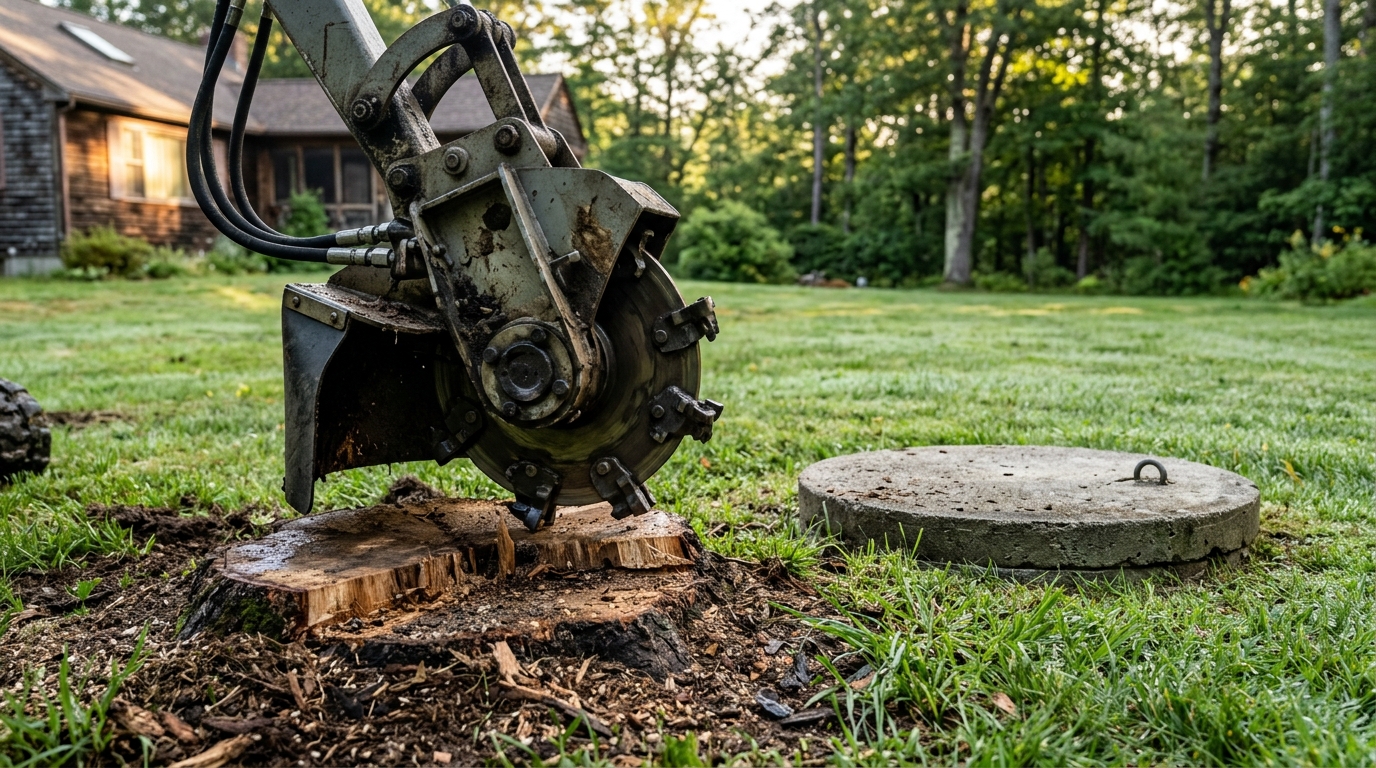
The buried stuff you can’t see is the whole ballgame
A stump sitting three feet from a septic tank cover looks like any other stump until the grinder wheel bites down and finds a pipe nobody mapped. That’s the part most folks don’t think about, and it’s exactly the part we think about first at Bump Your Stump. In Hopedale, a good chunk of homes run on private septic systems, and plenty of older properties have water, gas, electric, and communication lines that were buried decades ago without clean records. Grinding a stump is simple work right up until the depth and location put you on top of something expensive. This is what actually happens down there, and how we keep a routine job from turning into a flooded yard or a cut cable.
How close is too close to a septic system
A typical residential septic setup around here has a tank, a distribution box, and a leach field made up of perforated pipe laid in gravel trenches. The tank and D-box usually sit between one and three feet down. The leach field lines can run shallow, sometimes only six to twelve inches below grade at the edges. A stump grinder wheel chews anywhere from four to twelve inches deep on a standard grind, and deeper if you’re clearing for a new planting bed or a patio. Those numbers overlap, which is why proximity matters so much.
Tree roots make the whole thing worse. Roots chase moisture, and a septic field is the wettest, richest spot in the yard. We regularly find maple and willow roots that have wrapped a distribution box or crept into a leach line years before anyone noticed. When a stump is close to septic, the root mass you’re grinding through may already be tangled with the system. Grind blind and you can crack a pipe, collapse a trench, or pop the lid off a D-box without ever feeling it happen.
What a hit to the septic system actually costs
A cracked leach line isn’t a quick patch. Once effluent stops draining correctly, you get soggy ground, sewage odor, and backups inside the house. Repairs on a damaged field can run into the thousands, and a failed system that needs a full redesign and Board of Health permitting climbs much higher. That’s the math behind why we slow down near anything septic. A careful grind costs you a little patience. A wrecked field costs you a summer and a serious bill.
Signs a stump sits near your septic components
You can often spot clues before anyone digs. A rectangular patch of grass that greens up faster than the rest of the lawn usually marks a leach field. Round or square concrete lids flush with the soil are tank and D-box access points. A cleanout pipe sticking up near the foundation points toward the main line running out to the tank. If a stump sits anywhere along that path between house and field, treat it as a caution zone until it’s confirmed.
Underground utilities and why Dig Safe matters in Massachusetts
Massachusetts law requires a Dig Safe call before you disturb the ground, and that applies to stump grinding when the wheel is going below the surface. You dial 811, and the utility companies come mark the public lines with paint and flags. Gas, electric, water, and telecom all get located. It’s free, and skipping it is both illegal and reckless. A grinder wheel moving at speed will shear a cable or nick a gas line long before the operator can react.
Here’s the catch that trips people up. Dig Safe marks the utility-owned lines up to the point where they enter your property, but the private lines are on you. The gas line running from the meter to a detached garage, the electric feed to a shed, the water line to an irrigation setup, the low voltage wire to a landscape light near the stump, none of that gets marked by 811. Those private runs are often shallow and poorly documented, and they’re the ones we find the hard way if we’re not paying attention.
This is a big reason we treat careful planning as part of professional stump grinding services rather than an afterthought. Before the wheel touches wood, we want to know where the marks are, where the septic components sit, and what private lines might be hiding. A stump near a driveway or the corner of the house is almost never a simple grind, because that’s where the buried runs cluster.
What actually happens when a grinder hits something buried
Each type of strike plays out differently, and knowing the difference is what keeps a crew safe.
- A gas line strike can release gas fast and ignite from the spark of the cutting teeth, which makes it the most dangerous hit of all.
- An electric line cut can energize the grinder frame and the surrounding soil, creating a shock and arc flash risk.
- A water line break floods the hole and the yard, saturating soil and undermining nearby structures.
- A severed telecom or cable line knocks out phone, internet, and alarm service, sometimes for the whole street.
- A cracked septic or leach pipe leaks effluent into the soil and can take days to show as odor and soggy ground.
The frustrating part is how quiet some of these strikes are. A shallow irrigation line or a low voltage wire might get chewed without any obvious bang. You find out later when the sprinklers won’t run or the landscape lights stay dark. That’s why we look before we grind instead of grinding and hoping.
How we grind safely around sensitive ground
Our process near septic and utilities is slower and more deliberate, and it starts well before the equipment comes off the trailer. We walk the site with you, note every lid, flag, cleanout, and suspicious green stripe, and ask what you know about the property’s history. Older Hopedale homes often have additions and outbuildings that were wired or plumbed by whoever owned the place in 1975, so your memory is sometimes the best map we’ve got.
When a stump sits inside a caution zone, we adjust the plan. Sometimes that means grinding shallower and leaving the lower root mass in place rather than chasing it down toward a pipe. Sometimes it means hand-digging to expose a line before we touch it with the machine. On a leach field edge, we may grind only the visible stump and skip the aggressive surface root removal so we never get near the trenches. The goal is a smooth finished grade without a single strike on anything that matters.
There are stumps we recommend handling differently from the start. If a large tree is failing right over a septic tank, the smarter move is often reliable tree removal done carefully so the trunk comes down controlled, followed by a measured grind that respects the tank below. Dropping weight the wrong way near a buried tank can crack it just as easily as a grinder wheel can.
Depth control is the real skill
Anybody can run a grinder flat out. The skill is knowing how deep to go in a given spot and having the discipline to stop. Most lawn restorations only need the stump taken down four to six inches below grade so grass can grow back and you can mow without hitting anything. Going deeper than the job requires near septic or utilities adds risk for no payoff.
We also read the soil as we go. Hopedale ground has plenty of glacial till, so rock is common, but there’s a difference between the feel of a buried rock and the feel of a pipe or a conduit. When the wheel meets something that isn’t wood or stone, we stop and check by hand before deciding anything. That pause has saved more than a few water lines.
Spring here means saturated ground from snowmelt, and wet soil over a leach field is softer and more easily collapsed. Frost in the deep winter can heave shallow lines closer to the surface than they were buried. After a strong summer storm, washed-out soil can leave a shallow line barely covered. We account for the time of year because the same stump can carry different risk in April than it does in August.
When a stump is tied up with storm damage
After a nor’easter or a heavy summer thunderstorm, we get calls for trees that came down hard, root plates torn up and stumps half ripped from the ground. Those uprooted stumps are tricky near septic and utilities because the whole root mass has already shifted, and a line that used to run below the roots might now be exposed or displaced. Our storm damage cleanup work includes checking what moved underground, not just hauling off the wood up top.
An uprooted tree near a leach field is a double problem. The lifting roots may have already cracked a line as they tore free, and the crater left behind can hide the damage. We probe those craters carefully before grinding anything, because the last thing you want after a storm is a septic failure stacked on top of tree cleanup.
Why local experience changes the outcome
Knowing Hopedale properties is half the job. We’ve seen how the older neighborhoods were plumbed, where the newer subdivisions tend to run their private lines, and which lots almost always have a septic field tucked in the back corner. That pattern recognition means we ask the right questions before we start instead of discovering surprises mid-grind.
You can get a feel for the range of jobs we handle and how clean the finished grinds come out when you see our recent work in the gallery. The photos show the kind of tidy, level results we aim for, including work done on tight lots where careful placement mattered.
What separates a safe grind near buried systems from a gamble comes down to a short list of habits.
- Always calling Dig Safe before any below-grade grinding.
- Walking the property with the homeowner to locate septic lids and cleanouts.
- Asking about private lines to sheds, garages, irrigation, and landscape lighting.
- Grinding only as deep as the job honestly requires.
- Stopping to check by hand the moment the wheel meets something unexpected.
Ready when you are
If you’ve got a stump sitting close to a septic tank, a leach field, or any buried line and you’d rather not find out the hard way what’s down there, let’s talk it through before anything gets touched. You can schedule an appointment today and we’ll come look at the site, map the caution zones with you, and give you a straight answer on how we’d handle it.
The best outcome with this kind of work is boring. No flooded yard, no sewage smell, no dark landscape lights, just a stump gone and a lawn that grows back by next season. That’s what careful grinding near sensitive ground should look like, and it’s worth a little extra planning to get there.
Frequently Asked Questions
Can you grind a stump right over my septic tank?
Usually yes for the visible stump, but we keep the grind shallow and controlled so the wheel never reaches the tank lid or the pipes feeding it. We locate the tank and D-box first and plan the depth around them rather than grinding blind.
Do I really need Dig Safe for stump grinding?
Yes. Massachusetts law requires a Dig Safe call before disturbing the ground, and grinding below the surface counts. It’s free through 811 and it gets the gas, electric, water, and telecom lines marked. It does not cover private lines on your property, so we also ask you about those.
What happens if the grinder hits a septic leach line?
A cracked leach line leaks effluent into the soil, which shows up as soggy ground and odor and can lead to backups in the house. Repairs are costly, which is why we grind shallower and skip aggressive root removal near field edges.
How deep does stump grinding usually go?
For a standard lawn restoration we take the stump about four to six inches below grade so grass can grow and you can mow safely. We only go deeper when the job genuinely needs it, and we avoid extra depth near septic or utility lines.
Are private utility lines a bigger risk than the marked ones?
Often, yes. Dig Safe marks the utility-owned lines, but the runs to a shed, detached garage, irrigation system, or landscape lighting are private and usually unmarked. They tend to be shallow and poorly documented, so we rely on your history of the property to find them.
My tree was uprooted in a storm near my septic field. What now?
We check whether the lifting roots cracked or exposed a line before we grind anything, and we probe the crater left behind. Our storm damage cleanup handles the underground risk, not just the wood on the surface.